
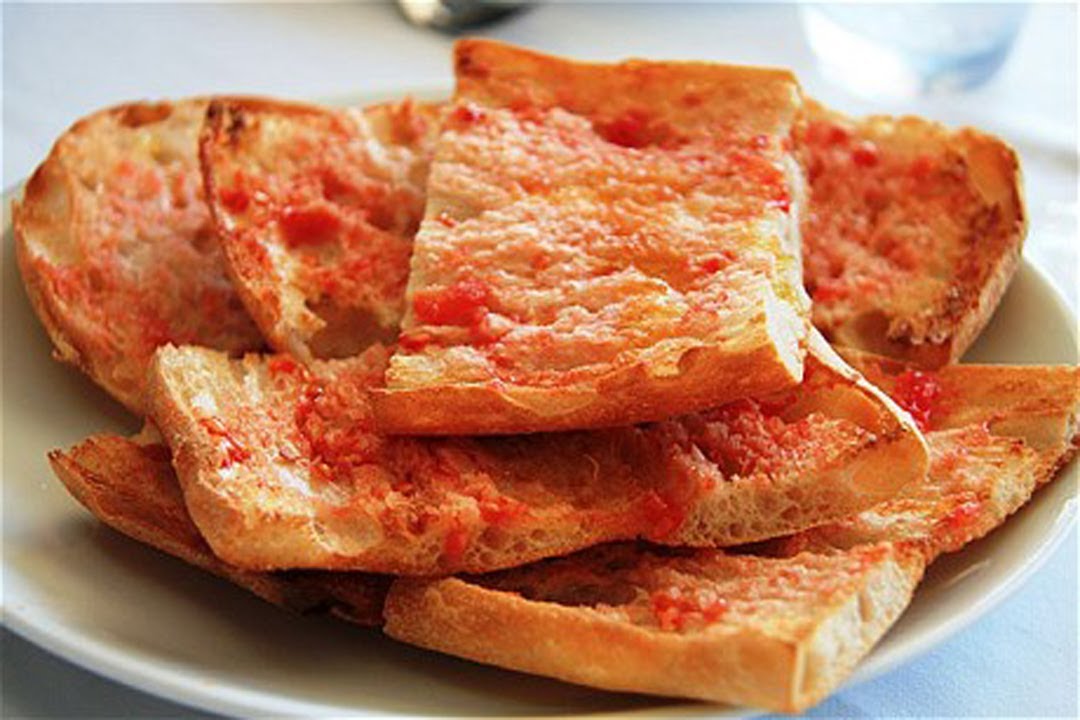
The origins of *pa amb tomàquet* (bread with tomato) are entirely uncertain. While various stories exist, they all possess a strong folkloric quality that renders them unreliable for a rigorous study. What is certain is that the tomato arrived from the Americas but did not become a kitchen staple until a century later. The use of tomatoes in the Catalan-speaking lands (*Els Països Catalans*) is not documented until the 18th century. It was during this period that the Majorcan friar Jaume Martí described *pa amb oli* (bread with oil) in his recipe book—the clear precursor to *pa amb tomàquet*. Regardless of its history, what truly matters is its role in the Catalan diet, spanning everything from the most glamorous settings to the humblest everyday meals.
The French magazine *La Revue des Gourmands* named Barcelona a "ville gourmande" (gourmet city) in 2002, giving *pa amb tomàquet* a place of honor.
*Pa amb tomàquet* is increasingly known worldwide as the perfect accompaniment to Serrano ham—or, better yet, Jabugo ham. Yet *pa amb tomàquet* is a feast in its own right; once it hits the table, it pairs beautifully with almost anything. It serves as a base that complements many other foods—such as *tortilla* (Spanish omelet), *fuet* (cured sausage), *botifarra* (Catalan sausage), grilled meat, and cheese—not to mention fruits like figs, cherries, or almonds. The combination of *pa amb tomàquet* with *tortilla*, Manchego cheese, and grapes is a true delicacy.
INGREDIENTS
The ingredients are so few that each one is crucial. Great care must be taken in selecting them, and one should not skimp on quality. This Catalan specialty is simultaneously so simple and sublime that a poor choice of ingredients can ruin the entire preparation.
THE BREAD
The bread should be a large loaf to ensure good-sized slices. The crumb must be firm enough to hold the tomato juice and oil without letting them soak through to the bottom. Originally, bread that had been sitting at home for a few days was used, and it was rubbed with tomato to make it easier to eat. Nowadays, fresh bread is used, though it should be well-settled (meaning it has had several hours to rest after baking). In Catalonia, *pa de pagès* (rustic country bread) is the standard choice. Elsewhere in Spain, this type of bread is known as *pan de pueblo* or *hogaza*. In France, a *pain de campagne* would be suitable.
The slices should be about a finger's width thick to make them easy to bite into.
THE TOMATOES
The tomatoes must be red and fully ripe—specifically the "hanging" variety (*tomates de colgar*) or Canary Island tomatoes. They shouldn't be too large; roughly the size of a ping-pong ball is ideal. Grating the tomato and then spreading it onto the bread with a spoon or brush is a bad habit. These are practices sometimes seen in the hospitality industry, signaling poor-quality tomatoes and shoddy workmanship by the cook.
THE OIL
The oil must always be olive oil—virgin or otherwise, depending on the consumer's preference and what accompanies the *pa amb tomàquet*. Bear in mind that *pa amb tomàquet* is a dish with a distinct Mediterranean character, making olive oil essential.
THE SALT
Salt is an ingredient that can be omitted without compromising the quality of the *pa amb tomàquet*. Whether to use it depends largely on the accompanying food; for instance, if the *pa amb tomàquet* is served with ham, you can easily skip adding salt.
There is no specific preference regarding the type of salt used. Sea salt, rock salt, or Himalayan salt are all perfectly acceptable options.
PREPARATION
Authentic *pa amb tomàquet* is made with a good slice of *pa de pagès* bread, red and fully ripe tomatoes, virgin olive oil, and salt.
To prepare it, cut the tomato in half across its equator. Take a couple of slices—about a finger's width thick—of *pan de pagès* (rustic country bread) that has had time to settle after baking. Rub a tomato over the surface, pressing down with your fingers to release all the juices and soak the bread. Using an oil cruet, drizzle extra virgin olive oil from a height of 10 centimeters, moving your wrist in a circular motion. Finally, add a little salt. Whether you rub the tomato on one or both sides of the slice is a matter of personal preference, though one side suffices if the slice is thin.